
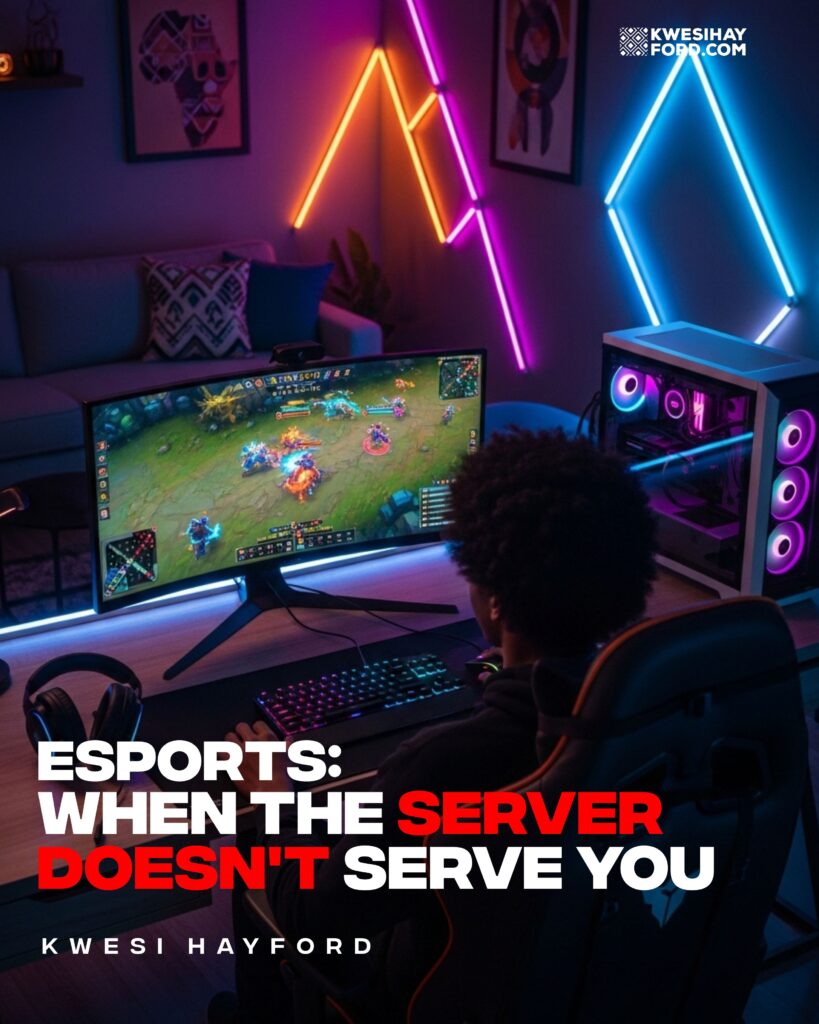
In online gaming and Esports tournaments, terms like server location, latency, ping, and milliseconds (ms) aren’t just technical jargon, they often determine who wins and who loses.
Simply put, the closer a player is to a game server, the faster their inputs are processed. When you press a button on your controller, that command travels to the game server, gets processed, and returns as an on-screen action. One can be the best player, but a server can determine one’s fate.
Low latency = faster response time and smoother gameplay
High latency = delayed reactions and competitive disadvantage
This is one of the biggest structural challenges facing Esports and online gaming across Africa.
THE SERVER GAP IN AFRICA
Most major game servers are still hosted in Europe or the Middle East. As a result, many African players experience average ping rates of 150–200 ms or higher, compared to 20–50 ms in regions with local servers. That gap directly impacts performance in competitive play.
Deploying servers isn’t the responsibility of one group alone. It requires multi-sector collaboration across:
1. Game publishers
2. Data centers & cloud providers
3. Telecoms & ISPs
4. Governments & regulators
5. The gaming community itself
While players sit at the end of the chain as consumers, community demand is one of the strongest drivers for server investment. However, because servers require significant infrastructure and financial commitment, publishers typically look for stable markets, strong connectivity, and clear user growth before deployment.
SIGNS OF PROGRESS, BUT STILL LIMITED
There has been a deployment of servers by some Publishers, an example is Electronic Arts (EA) exploring or testing server presence in Nigeria, which has significantly improved connectivity across West Africa with respect to the EAFC game title. North Africa, by proximity to Europe, mostly plays on European or Middle East servers.
South Africa has servers that are supported by local providers, which offer dedicated hosting and optimised routing for low-latency gameplay within the country.
Yet the reality remains: most major game titles still lack dedicated African servers, largely due to perceived market size, infrastructure challenges, and investment risk.
THE “SERVER IN AFRICA” CAMPAIGN
For years, we’ve been advocating for fair digital infrastructure in gaming.
Our petition has gathered over 2,000+ signatures calling on major publishers to recognize Africa’s growing gaming economy and invest in local servers.
++++——————–
Have you signed yet?
++++——————–
Server or no server, Africa still plays.
We adapt. We compete.
We build communities.
And when online systems fail us, we keep gaming offline, locally, and creatively.
WHEN THE SERVER DOESN’T SERVE US, WE SERVE OURSELVES OFFLINE!
As always. More Vim,
Kwesi Hayford
President of Esports Ghana