
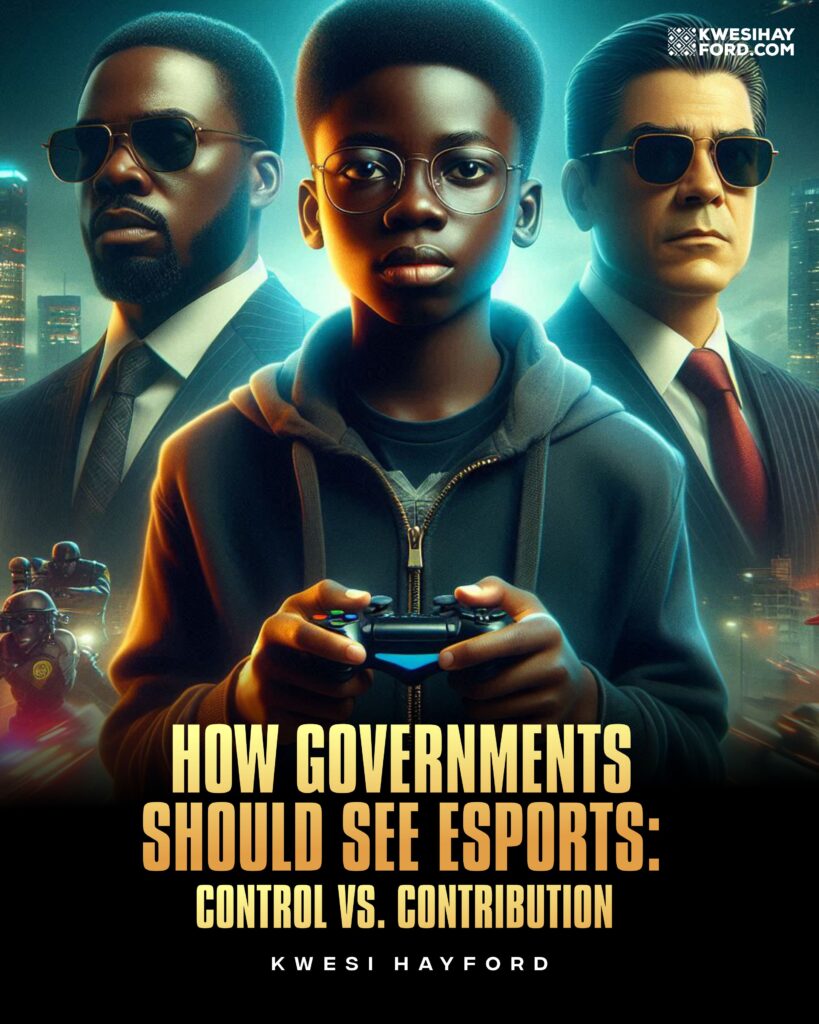
Let me paint a picture for you.
Esports in Africa today? It’s like a toddler in its formative years, full of potential, curiosity, and raw energy, but still learning to walk. And yet, too many Governments are not aware of this child and even if they are, already trying to dictate how it should step… without ever having laid down the floorboards.
Here’s the truth! Across much of the continent, Esports remains an undiscovered frontier in national policy. No blueprint. No institutional roadmap. Just passionate communities building something powerful from the ground up, often with little more than grit, sacrifice, low-level budgets and limited resources.
And that’s the key insight: an ecosystem built by the people cannot be controlled by those who haven’t contributed to its foundation.
Think about it:
- The games? Not owned by the government.
- The hardware? Bought out of gamers’ own pockets.
- The spaces? Community-run game centres, bedrooms, and makeshift LAN setups.
- The data? Paid for by young players sacrificing lunch money to stay online.
- The programs? Organised by volunteers, associations, and members, not ministries.
So how can anyone claim authority over a culture they haven’t nurtured?
Control without contribution isn’t governance, it’s gatekeeping. In today’s world, much efforts must be built into collaboration and sustainable venture that elevate communities not control.
BUT WHAT IF WE FLIPPED THE SCRIPT?
What if governments chose contribution over control ,and responsibility over regulation ?
Imagine this:
1. GAMES
Partner with publishers to host local servers. Fund grants for African game developers creating homegrown Esports titles. Provide Game Development Grants for Startups to development game to be used as Esports titles in School Leagues and University Championship.
2. HARDWARE
Introduce tax incentives on gaming PCs and peripherals, making tools of the trade affordable for talent everywhere. Partner with the Private Sector for Gaming PC Assembling Plants, Monitors, Peripherals, and even Gaming Chairs to drive broader ecosystem growth. Local manufacturing for certain gaming devices will boost the economy.
3. SPACES
Build multi-use Esports Hubs, not just arenas, but creative ecosystems: e-classrooms, streaming studios, Esports Teams co-working zones, creative design labs, streaming cafes, editing workstations, performance research space, robotics tournament arenas, drone flight arenas, photography studios, and viewing centres with restaurants.
4. DATA
Collaborate with telcos to offer youth-focused data bundles. Even better, mandate a 1% industry contribution to a National Esports Youth Empowerment Fund.
5. PROGRAMS
Launch a structured National Youth Esports Empowerment Program, tying competitive play to real-world skills: coding, content creation, event management, and AI literacy.
6. EDUCATION
Embed adaptive Esports modules into primary and secondary curricula. Not to replace Physical Education (PE), but to complement it. Use gaming as a gateway to STEM, STEAM, robotics, and digital fluency. Promoting stronger Cognitive and Mental Education (ME)
This isn’t fantasy. Its strategy that will work well for any government with a National Esports development vision and policy towards the future of work and better livelihoods.
When governments treat Esports not as a distraction but as a national development vector, they unlock a pipeline for youth engagement, digital citizenship, and future-ready employment.
Ghana. Africa. The future we want? It’s being played, streamed, and competed into existence right now by our young people.
All they need is partnership, not permission. Contribution and not control.
So I simply ask the big question…
How can your Government institutions shift from controlling Esports… to contributing to it?
Let’s build with the community, not above it.
As always,
More Vim.
Kwesi Hayford